ECHOES OF THE DELTA
They watched in horror as their children fell ill, their crops withered, and their very existence was reduced to a mere afterthought in the pursuit of oil.
                                                                                                 .

In the depths of the Niger Delta region of Nigeria, West Africa, where the majestic waters of the Oloibiri River once made my homeland thrive, I witnessed a story of broken promises and shattered dreams unfold like a dark, suffocating shroud around me. The discovery of crude oil, which was supposed to be a blessing for us, has instead brought suffering to my people. The region's lifeblood has been drained, leaving devastation and pain behind like an open wound that refuses to heal. The once-clean creeks are now polluted, a haunting reminder of my people's struggles that I see etched in their eyes every day. They cry out in despair as our ancestral land is destroyed, and I feel their pain deeply. The air is thick with hopelessness, like the constant smoke in the skies as my people's cries for social and environmental justice were met with deafening silence that left us feeling abandoned. This nonchalant attitude of the authorities concerned towards the plights of my people fueled the embers of militancy, and set the stage for a heart-wrenching struggle that would echo through the Deltas for generations to come, a struggle I saw consume many young lives.

I recall the story of the sense of excitement and promise that filled the air in 1956, when the first droplets of crude oil were struck at Oloibiri, a small town located in the present Ogbia Local Government Area of Bayelsa State, in the Niger Delta's region, Nigeria - a place I call home. The discovery, hailed as a game-changer for our region's economy, marked the beginning of a new era for us, as indigenous and foreign companies, with names like Shell, Chevron, and Mobil, descended upon our land, eager to tap into the black gold that lay beneath our feet. With the Nigerian government's blessing, these oil giants began their exploration, drilling deep into the earth, and extracting the precious resource with reckless abandon that seemed to care little for our well-being. The once-peaceful creeks and rivers became a maze of pipelines, rigs, and platforms, as the Delta's landscape was transformed into a sprawling industrial complex, leaving my local population to navigate the treacherous waters of displacement, pollution, and neglect that took a toll on our spirits. As the oil flowed, so did the promises of prosperity and development for us, but the benefits, like the oil itself, seemed to slip through the fingers of my Delta's people, leaving only a sticky residue of despair that I see in the faces of my neighbors.

As I reflect on those days, I remember how the Delta's delicate ecosystem began to unravel with the explorers' machinery roaring to life. The air grew thick with the acrid smell of sulfur and grease, while the waters, once teeming with life that fed my people, turned a murky brown, choked with the effluent of oil spills and drilling waste. The mangrove forests, ancient sentinels of our coast, withered and died, their tangled roots suffocated by the creeping tide of pollution that I watched claim our natural heritage. My indigenous people, who had lived in harmony with the land for generations, found themselves cast aside, their ancestral homes destroyed, their fishing grounds poisoned, and their way of life disintegrating like sand between fingers. We watched in horror as our children fell ill, our crops withered, and our very existence was reduced to a mere afterthought in the pursuit of oil that seemed to blind those in power to our humanity. The sounds of the Delta, once a symphony of birdcalls and gentle lapping of the waves that I loved, were now drowned out by the cacophony of drilling, the rumble of trucks, and the anguished cries of my people betrayed.

For years, I saw my people plead with the government and the oil companies to heed our cries, to recognize our rights, and to mitigate the devastation that was eating away at our souls. We organized peaceful protests, wrote petitions, and engaged in dialogue, only to be met with indifference, deception, and betrayal that cut deep. Our leaders were co-opted, bribed, or silenced, while our people suffered in ways that seemed to have no end. The oil companies, with their slick public relations and cleverly crafted lies, convinced the world that they were the harbingers of progress for us, while the government, complicit in the plunder, looked the other way as we bled. But as the years turned into decades, and the degradation deepened like an open sore, my people's patience wore thin. The peaceful protests gave way to angry demonstrations, the petitions turned into fiery manifestos, and the dialogue devolved into confrontation that threatened to consume us all. My indigenous people, driven by desperation and frustration that had built over years of neglect, began to take up arms, forming militant groups to fight for their rights, their land, and their very survival.

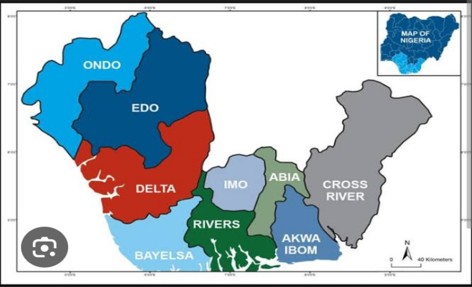
The Niger Delta, a region comprising nine Nigerian States of Bayelsa, Delta, Rivers, Cross-rivers, Edo, Akwa-ibom, Ondo, Imo and Abia, once a tranquil landscape, was now a battleground, scarred by the conflicts, and stained by the blood of those who dared to resist. The echoes of the Delta, once a gentle whisper, had become a deafening roar, a call to action, a cry for justice, and a warning to those who would continue to ignore the plight of the people.

Driven by frustrations with the Nigerian government's perceived neglect and exploitation of the Niger Delta's resources, militant groups, with names like MEND and NDPVF, emerged as a force to be reckoned with, determined to disrupt the oil production that had ravaged their land. MEND (Movement for the Emancipation of the Niger Delta) emerged in 2005 while NDPVF (Niger Delta People's Volunteer Force) was formed in the early 2000s, led by Mujahid Dokubo-Asari. They launched daring raids on pipelines, blowing them up with explosives, and sabotaging the flow of oil. They attacked oil rigs, kidnapping foreign workers and holding them for ransom. They blockaded ports, preventing tankers from loading the precious cargo. And they issued statements, broadcast on the internet, outlining their demands: environmental restoration, fair compensation, and a greater share of the oil revenues.
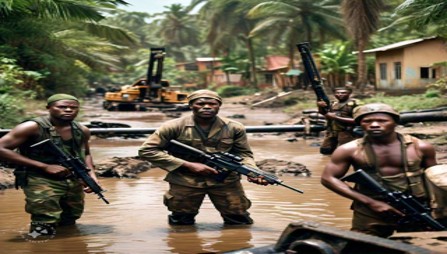
Militants in the creek determined to sabotage the exploration and flow of oil in order express their grievances to the government.

The government and oil companies, caught off guard by the militants' audacity and organization, struggled to respond to the demands made by the militants. They deployed troops, who clashed with the militants in bloody battles, but the fighters seemed to always slip away, melting into the mangrove forests like ghosts. As the conflict escalated, the oil production began to dwindle, and the world began to take notice of the Niger Delta's struggle for environmental justice. The echoes of the Delta were now a global call to action, a reminder that the true cost of oil was not just measured in dollars, but in the lives and livelihoods of the people who called the Delta home.

Nigeria's economy which mostly relied on crude oil production was negatively affected as the Niger Delta's creeks burst into chaos, with militant groups attacking the oil companies that had harmed their land for years. The strong pipelines were now broken and still, with oil spilling into the dirty water. Polio's oil rig, once the pride of Nigeria's petroleum industry, stood idle, its steel behemoth silenced by the militant's explosive wrath. The year was 2006, and the Niger Delta's militancy had reached a boiling point. MEND's attacks on oil infrastructure had crippled production, slashing Nigeria's daily output by 40%.

As the oil taps ran dry, the nation's economy began to hemorrhage. The Naira, once a symbol of pride, lost value fast, like a falling stone. Inflation, a silent enemy, spread across the land, closing businesses, factories, and causing people to suffer. Nigeria's economy, once strong like a river, was now weak. The country's wealth, once boosted by oil, was now shrinking. The echoes of militancy in the creeks had unleashed a tsunami of economic devastation, leaving in its wake a nation on the brink of collapse. But, amidst the destruction, a glimmer of hope appeared. The government finally took action, offering militants a chance to stop fighting and start anew.

Initially, the government responded to the militants' actions with a mix of force and token concessions. Before the Yar'Adua administration's amnesty program, the Nigerian government responded to militancy in the Niger Delta with a range of ineffective measures. These included deploying military forces to quell the unrest, resulting in human rights abuses and further escalation; arresting and detaining militants without addressing the root causes; setting up security agencies like the NDDC and JTF to address security and development concerns; promising development projects that were often unfulfilled or mismanaged; using oil revenues to appease some militant leaders, creating a culture of patronage; and simply ignoring the problem, hoping it would resolve itself. These responses failed to address the underlying issues driving militancy, such as environmental degradation, poverty, and lack of representation, ultimately exacerbating the situation.

The indigenous people of the Delta, through their leaders and representatives, demanded a comprehensive package of reforms to restore peace and economic activity to the region. They called for the cleanup of polluted lands and waters, and the restoration of damaged ecosystems. They demanded greater autonomy and control over their resources, and a fairer share of the oil revenues.

They also sought compensation for past injustices, and guarantees of transparency and accountability in the management of the oil industry. Furthermore, they demanded investment in infrastructure, education, and healthcare, to address the chronic underdevelopment of the region. Above all, they insisted on being treated as equal partners, rather than mere subjects, in the decisions that affected their lives and their land.

Successive administrations in Nigeria have made efforts to address the plights of the people of the Niger Delta's region, but some have been more effective than others. The administration of President Olusegun Obasanjo established the Niger Delta Development Commission (NDDC) to oversee the development of the region, but its impact was limited by corruption and inefficiency.

The administration of President Umaru Yar'Adua introduced the Amnesty Programme, which led to a significant reduction in militancy, and also initiated the Ogoni Cleanup Programme, a landmark effort to restore the environment of the Ogoni people, who had suffered decades of oil pollution. However, the administration of President Goodluck Jonathan, himself a native of the Niger Delta, made the most giant strides towards addressing the problems of the region. He built on the efforts of his predecessor, launching the Niger Delta Master Plan, a comprehensive blueprint for the region's development, which emphasized infrastructure development, environmental remediation, and economic empowerment. He also increased the allocation of oil revenues to the region, ensuring that a greater share of contracts and jobs went to indigenous companies and workers.

Additionally, his administration implemented the 17% derivation fund, which ensured that oil-producing states received a significant share of the oil revenues. Furthermore, he introduced scholarship programs for students from the region, and initiated the dredging of the Niger Delta rivers, to improve navigation and boost economic activity. Other initiatives included the establishment of the Presidential Amnesty Programme, the Niger Delta Basin Development Authority, and the Ministry of Niger Delta Affairs, all aimed at addressing the region's unique challenges. While challenges still remained, these efforts marked significant strides towards addressing the problems of the region, and laid the foundation for future progress.

Foreign oil companies operating in the Niger Delta have also made efforts to fulfill their social responsibilities towards their host communities. Many have established corporate social responsibility (CSR) initiatives, aimed at addressing the environmental and social impacts of their operations. These initiatives have included investments in education, healthcare, and infrastructure, such as building schools, hospitals, and roads. Some companies have also implemented environmental remediation programs, aimed at cleaning up oil spills and restoring damaged ecosystems.

Furthermore, companies like Shell and Chevron have established development programs, aimed at empowering local communities and promoting economic development. For example, Shell's LiveWIRE program provides training and funding for young entrepreneurs, while Chevron's Partnership Initiatives in the Niger Delta (PIND) supports local economic development projects. While these efforts have been welcomed by some, others have criticized them as insufficient, given the scale of the environmental and social challenges facing the region. Nevertheless, they represent an important recognition by foreign oil companies of their responsibilities towards their host communities.

Successive administrations like that of the Buhari's and this present one have built upon the Yar'Adua's initiatives to alleviate suffering in the Niger-Delta regions. Theses key efforts are summarized below :
- Continuing the Presidential Amnesty Programme for ex-militants and youths.
- Infrastructure Development.
- Advancing the Ogoni clean-up process to address oil pollution.
- Establishing modular refineries and export processing zones to boost local economies.
- Allocating more resources to the Niger Delta Development Commission (NDDC) and Ministry of Niger Delta Affairs.

The story of the Niger Delta comes full circle, showing the power of fighting back, being strong, and working together. From a place of environmental damage and unfair treatment, a new story begins - one of hope, new beginnings, and determination. The voices of the Delta, once cries of sadness, now echo with promises of a better future, where people's rights are respected, and the land is valued for its beauty and resources. As this chapter ends, we feel amazed and inspired by the bravery and conviction of those who challenged the status quo, and excited for a new start, where the Niger Delta rises from the ashes of neglect and oppression, to become a symbol of success, peace, and harmony.


________________________________________________________________________


Frederick Agene: As a Nigerian activist and writer, I've dedicated my life to amplifying marginalized voices and shedding light on the region's struggles. My work aims to inspire action and drive change.

