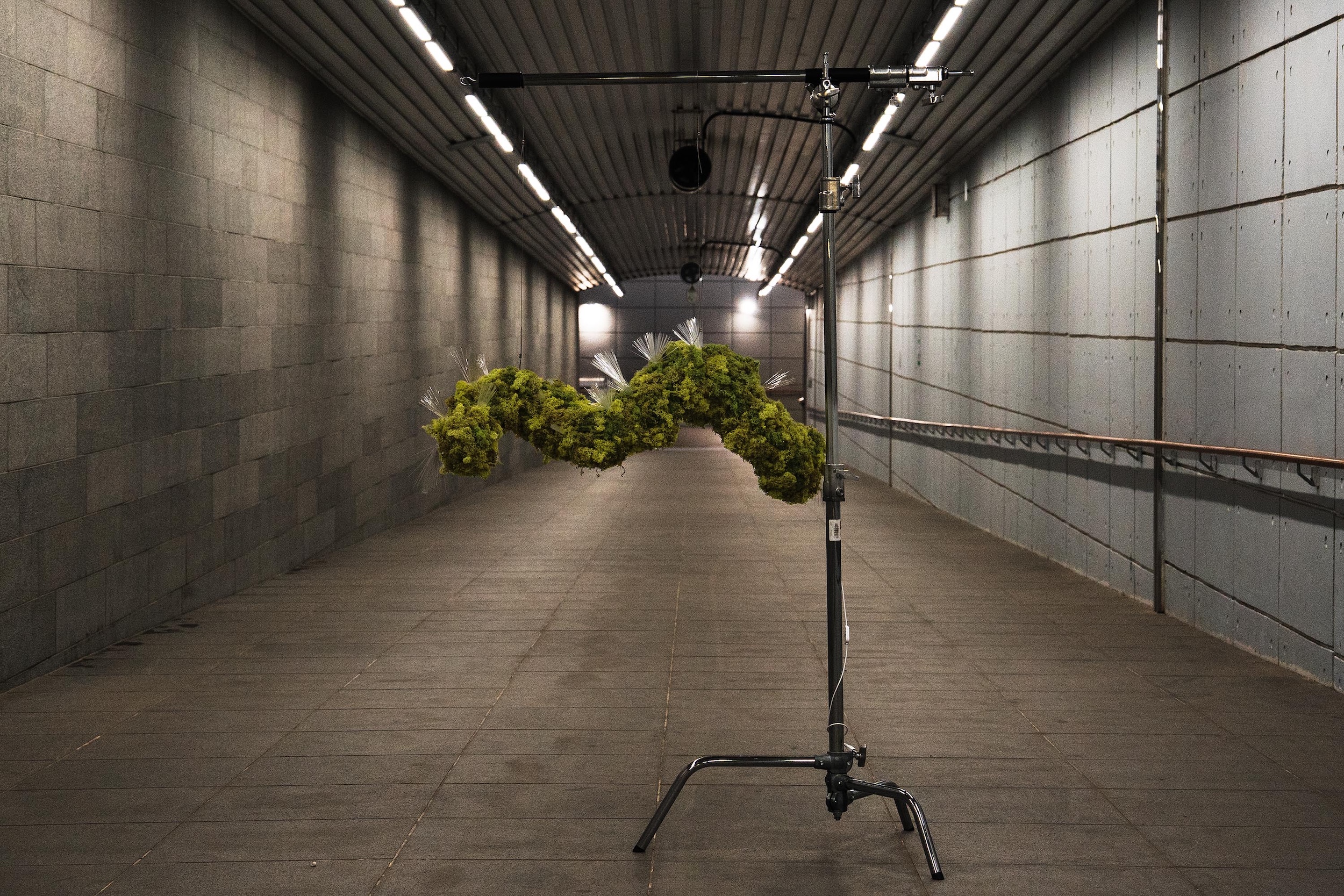
“The Hidden Piloti of the City” © 2026, Siwoo Park
This work was conceived from the perspective that natural elements within society function as a “Social Piloti,” providing essential mental and physical benefits to its inhabitants. To visualize this concept, I placed a stainless steel structure at the center to symbolize the artificial city, then integrated moss and foam to evoke natural forms.
The fiber optic light emanating from the crevices of these natural forms symbolizes the invisible yet vital role nature plays in maintaining a healthy urban environment—an influence that often goes unnoticed. Furthermore, just as a hanger structure achieves balance only when something is suspended from it, this piece suggests that a truly harmonious environment is formed only when nature is integrated into the urban framework. Through this process, I realized that nature is not merely a decorative element, but a “social piloti” that fundamentally supports and sustains the city.
Siwoo Park is a student at BC Collegiate and an aspiring artist who explores the intersection of history, policy, and everyday lives. She uses photography and product design to examine how spaces shape behavior and identity. Inspired by architecture and personal experience, her work reflects on the unseen forces that define daily life. She is pleased to submit her photographic series Social Piloti along with its extended work, The Hidden Piloti of the City.
The Social Piloti series (A Pause in Relation, Breathing between Forms, Common Ground) explores how natural ecosystems function as invisible structures that quietly support life. Expanding on this foundation, The Hidden Piloti of the City reinterprets these ecological principles within an urban context, suggesting that nature continues to act as an unseen support system for human well-being even in artificial environments.
Through this progression, her work connects to the themes of hope and possibility by proposing that overlooked natural systems hold the potential to restore balance and harmony in contemporary life. It reflects the idea that recognizing and reintegrating these hidden supports can lead to more sustainable and resilient futures.

