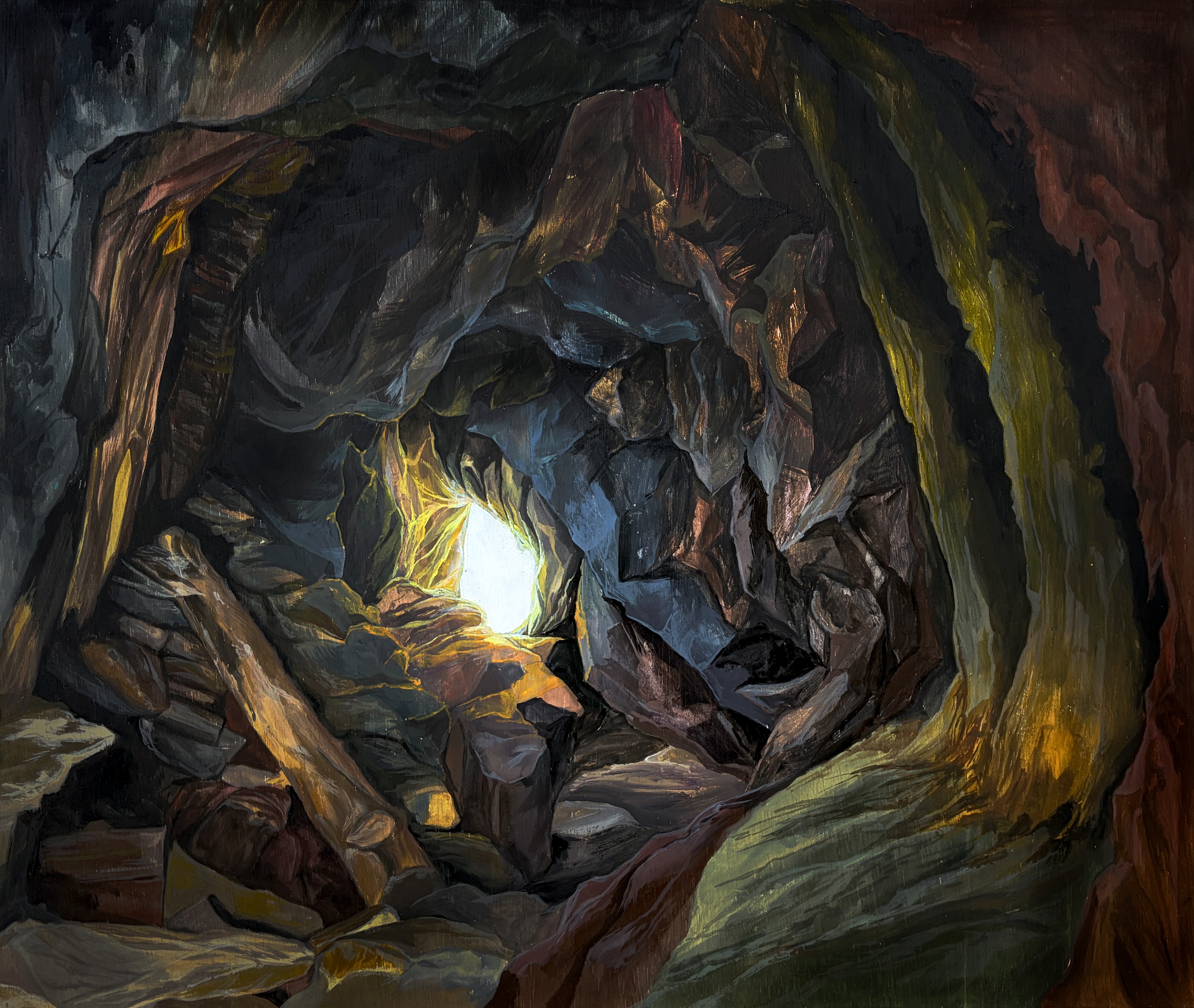
“Threshold” © 2026, Hyangyu Lee
This work sets the inner self as a cave and explores the relationship between the process of recovery and the movement toward the outside world through the visual device of light entering from the end of the cave. The narrow and irregular structure inside the cave represents a state of isolation. The light coming from outside the cave indicates a direction toward the exterior. Acrylic paint is used to create the rough texture of rock, and layered brushstrokes are applied to build the depth of the cave. Dark tones and strong contrast are used to emphasize the internal structure of the cave. Bright colors are concentrated in the area where light enters to guide the viewer’s eye. Through this process, a visual flow from the interior of the cave to the outside is constructed. The position of the light and the contrast clearly reveal the direction of movement and the presence of an exit. As a result, the transition from the inner space to the outside can be recognized as a defined path.
Hyangyu Lee is a student in CITYHILL Academy, Korea, multi-disciplinary artist whose practice explores the fragile and often contradictory process of healing through material and spatial investigation. Working primarily with bleached paper, drawing, and installation-like compositions, she uses the act of removing color as both a physical and symbolic gesture—mirroring the unpredictable and irreversible nature of revisiting past wounds.
Her work constructs psychological architectures composed of walls, curtains, and doors, each embodying varying degrees of permeability and self-protection. Within these spaces, tangled masses of string or wire emerge as unresolved forms, quietly insisting on what cannot yet be undone or understood.
Through pieces such as On Mending 1 and On Mending 2, she examines how memory, trauma, and recovery unfold across layered temporalities. Rather than proposing resolution, her practice reveals healing as an ongoing condition—one that moves between concealment and exposure, risk and possibility. Drawing from the logic of material transformation, she suggests that restoration is not an act of erasure, but a continuous negotiation with what remains.

