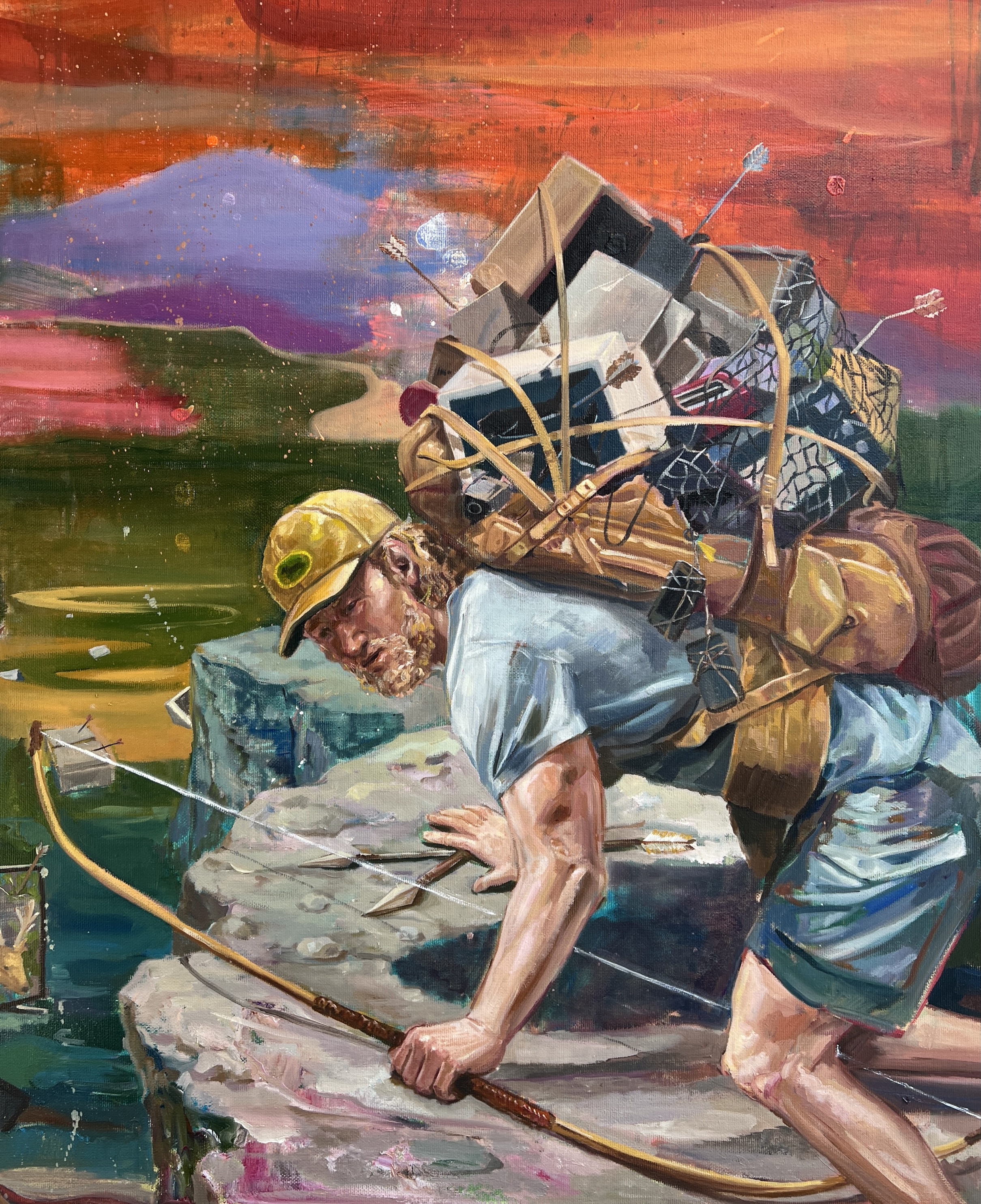
“Wrong Prey” © 2026, Jaewoon Jeong
This painting depicts a world long after the passage of time. Electronic devices no longer function, and the world has fallen into ruin. We do not know what caused it to become this way, but it is clearly a world very different from our own.
The figure in the painting crouches in the posture of a hunter. However, what they pursue is neither an animal nor food, but electronic devices. Their back is already burdened with items they have “hunted,” and arrows are lodged among them. Below the cliff, a television screen displays a deer, yet the figure’s attention is fixed not on the deer, but on the television itself.
No matter how much time passes, and no matter how completely the environment changes, humans continue to desire things they no longer truly need. Through this scene, I wanted to convey the idea that while time can transform many aspects of the world, it cannot so easily change human desire.
I am pleased to submit my works Wrong Prey and Fragmented Time, which explore the persistence of human desire and the fragmented perception of time. In a devastated future, Wrong Prey depicts a figure still chasing obsolete objects, revealing how desire can outlast necessity. Fragmented Time visualizes how time is experienced unevenly, shaped by emotion and perception rather than continuity. Together, these works reflect on human limitation—but also point toward hope and possibility. By exposing patterns of desire and perception, the works suggest that awareness itself can become a starting point for change. Even in a broken world or within fragmented time, there remains the possibility to rethink what we value and how we move forward.

