CHECKPOINTS
The name should have been Chuck for alliteration, but there it was, unremarkable, a road with a barrier and soldiers at the gatepost. My Indonesian passport and purchase of ten East German marks enabled entry. The year was 1979, a grey January morning.
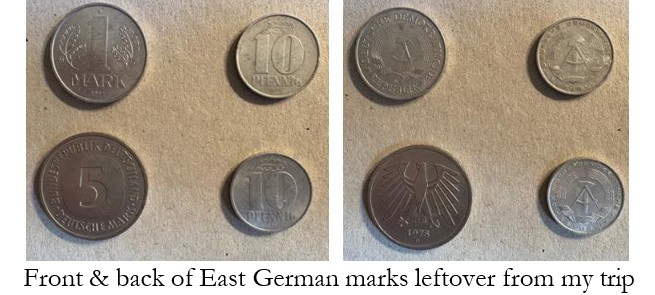
Seventeen years later I was in Berlin and bought a piece of the wall from the museum, a gift for Dad.
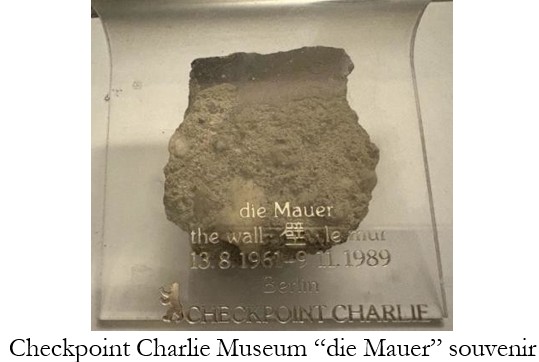
Like the wall, Dad’s long gone, as is my Indonesian passport after I became American, as Indonesia does not brook dual citizenship. Yet now, as checkpoints appear daily in my adopted country, and entry, costing far more than five marks, is increasingly restricted . . . is it time to ask, will America’s borders one day be a wall greater than China’s, my original country of origin?
Borders are personal. I went to East Berlin because I could, because Indonesians jumped through hoops for visas to go just about anywhere. Other than the ASEAN nations, I even needed visas to transit countries. In my early travel years, I worked for an airline and wanted to see the world, and jumped at every opportunity to travel despite the hours, days and weeks spent at consulates and embassies. The first time I short-circuited my work life in mid 1980 in favor of “becoming a writer,” I spent a year writing in Greece, England and France, shuttling between borders on multiple visitor’s visas to remain legal. This was partly due to my having been a foreign student in college in the U.S., resulting in the belief that the pursuit of happiness (and self-discovery) was a worthy way to live.
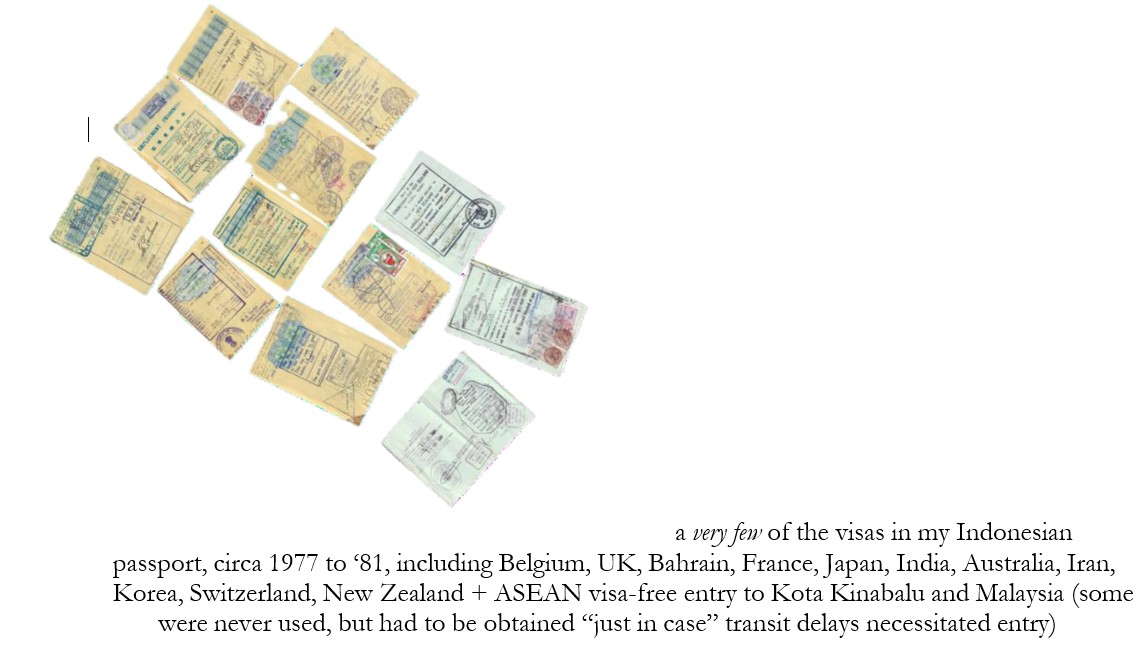
Meanwhile, Americans swarmed into my birth city Hong Kong when China opened to the world in 1978, just as they swarmed around the world with backpacks, stopping here, there and everywhere they pleased. By the 1990’s, the decade before Hong Kong’s return to China, there were more Americans than British living and working in the city, this perfect entry point to the Chinese market. The most economically powerful nation likes stamping its giant footprint if there’s profit to be made. What was it like to travel and work legally on a passport that got you so easily across almost every border, except the likes of, say, East Germany’s or the USSR’s? Americans, it seemed, were welcome everywhere. Even though I am a Hong Kong 永久居民 forever citizen who once had rights to a semi-British passport, back when we were still a colony, that passport still required a visa to enter Britain.
I was an accidental Indonesian, part of the Chinese 華僑 diaspora born to Indonesian-Chinese parents who had left their birth country after WWII for education and greater life opportunity overseas. In defiance, Germany became one of my early adventuring ports of call because I did not need a visa, and could crossover at Checkpoint Charlie where Americans could not. So there. Having bumped up against enough barriers for jobs or other life opportunities due to my nationality, mixed-Asian ethnicity, gender and simply not being rich enough for that rarified world of easy connections, there I was, twenty-five, educated, curious and impatient, adventuring life as much as possible without bankrupting myself.
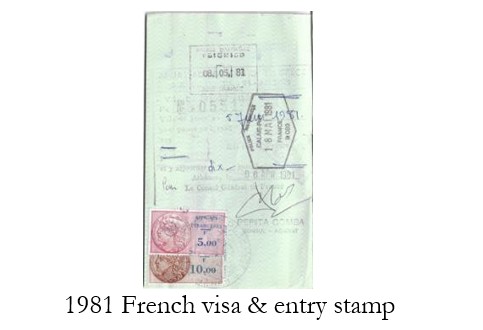
In 1981, I went to Russia because I could, because Americans couldn’t as easily as Indonesians, because an Italian paramour stood me up in Athens. Off I went by sleeper train from Athens to Moscow. The journey took three days, I could only afford a five-day stay, with a return destination to Paris where my sister lived. Ma soeur habite à Paris, I smiled at the French embassy official in Athens who winked back and granted a 10-day transit visa.
History is personal. I chose to become American because I didn’t think enough of monarchy to elect a British passport, and a democratic nation of immigrants appeared a viable alternative. When I naturalized in 1987, Indonesia had long been independent from the Netherlands. But having grown up in Hong Kong, too little of me was Indonesian and I did not like slipping cash into my passport just to avoid problems at the Indonesian immigration checkpoint. Yet now, as that country shores up its democracy and eradicates corruption, while I’ve been trying to shore up my Indonesian language ability, is it time to ask, did history hand me a Hobson’s choice?
When should you checkpoint the soul? Since ceasing full time work last year, I am now a candidate for the joys of retirement in my adopted country. Yet these interesting times I retired into are neither restful nor joyful. Instead, the daily news pricks at my civic consciousness, outraged by the erosion of American democracy in favor of an imperial presidency. Instead, I look suspiciously at my fellow Americans, wondering who might denounce me to I.C.E. because I don’t look American enough? When I pledged allegiance, US Immigration rules said citizenship could be revoked if you were found guilty of treason, although the Constitution back then still held some sway. As the definition of our rights as citizens are constantly re-defined, whether our rights to free speech, vote, protest, carry arms, or be offered due process by law, and we are barraged by too many alternatives to factual reality, is it time to checkpoint my loyalties, and suspend desire for the safe silence of senior citizenship?
It’s easier to be a senior citizen than one who is not yet senior. My generation paid into and receive our Social Security and Medicare, and can own a home and be financially stable enough to afford retirement. I am even so fortunate as to be a tech literate boomer, and, despite being childless, know how to program my television and corral the internet, unlike some of our senior government representatives who cannot articulate, logically, anything vaguely technical (the internet “a series of tubes,” really?) Given all the AI checkpoints that create a new obstacle course to daily life — banking, shopping, filing and paying taxes, obtaining government information or business customer service, being paid or refunded, booking restaurants or travel, watching news or entertainment or sports (how many subscriptions do I need to watch a season of my one favorite baseball team?) — it’s a relief just being able to circumvent the daily hacks, spams and phishing outreach. The websites, operating systems and apps that constantly need “upgrading” are also daunting tedium.
I am healthy enough not to have to rely on an iffy medical system (if you have insurance then maybe we’ll treat you) or social services. Yet isn’t this same government infrastructure that keeps us afloat also supposed to be one that cares for those who need help, offering some parity in light of the great social and economic inequities in this super-wealthy nation where too many people must live paycheck to paycheck (assuming they won’t be laid off, downsized, or otherwise tossed to the wolves of despair)? Isn’t there a promise inherent in U.S. citizenship, regardless of race, ethnicity, gender, religion, political affiliation, country of origin or the exigencies of your life, that your country will look after you? Isn’t that why those who can donate and contribute service to nonprofits, whether religious, social, educational, special interests, because this is a citizenry that believes in creating a balanced society, one that gives everyone a chance. After all, aren’t we still all created equal and offered that opportunity for the pursuit of happiness?
I am that immigrant and racial-ethnic minority who benefitted from D.E.I., who has employed Americans (and other nationals), both in the U.S. and internationally, from right across the racial, ethnic, gender and religious divides, either through my various managerial positions in business or as a program director in academia, or in the two small, private corporations I’ve run. And that paid employment included white men, so there. Yes, it is possible to be diverse, equitable, inclusive and also completely fair-minded, because the “best” candidate is determined not by loyalty, but by ability and experience. Despite enough challenges (after all, life encounters hurdles), it’s made for a good life, one I can reflect back on with a modicum of pleasure.
Why are there so many checkpoints to happiness these days? Has America forgotten the meaning of joy?
Facts are not personal. Lies are.
Fact: America is still one of the richest nations in the world, with more opportunities than most other countries for education, work and opportunity to make a good life.
Fact: America is a diverse nation, made up of immigrants because everyone, except the Native Americans, originally came from somewhere else.
Fact: America freed its slaves, but yes, slavery happened no matter how much anyone tries to rewrite history.
Fact: America has interned people of non-white races whose greatest crime was being that particular race at a particular moment in history. Once it was the Japanese, today it is anyone vaguely Latino or Hispanic. And tomorrow, perhaps you.
Fact: What happens is history, what AI memes is not.
Fact: There are no alternative facts, only alternative interpretations of what you want to believe, regardless of the facts.
Will we surrender to a reality that eschews the Constitution, the rule of law, the three branches of government, our fourth estate, plus basic fair play and human decency in favor of embracing “alternative facts”? Will we continue to tolerate a leader who spews lies daily, from a perch the world must acknowledge, just because he needs to soothe his ego?
I cannot surrender my adopted country, even though it’s hard to be proud to be American right now. I remember the day I was sworn in as a citizen, and my first two acts was to register to vote and apply for a passport. By now, I’ve traveled many more years on my U.S. passport than my Indonesian one, and breezed through many of the world’s checkpoints with ease.
Last year, I was in Jakarta and privileged to be part of a “fireside chat” panel for The Jakarta Post, speaking on “suspended narratives,” negotiating the role of stories in our fractured world. Their journalist who interviewed me afterwards posed an interesting question: When is a story yours to tell? Is my story even mine, if I represent the multitudes of identities and other factors that shaped who I am in this moment? This is increasingly relevant in our fractured times, when even memes want to tell “their” stories. One thought I offered was this: the question of whose story you can tell has a lot to do with why you want to tell it, and how you tell it.
I’m a writer, I believe in the how and why. How rude, how bombastic, how outrageous a story, because you need to be emperor of all you survey, with or without your underpants. Tell the emperor, why don’t we? We’re all that child in Anderson’s fairy tale who believed his own eyes.
The U.S. contributed much to my well-being, including the opportunity to pursue happiness as a writer.
My country is personal.
This abrasively political moment will pass as we still anticipate an eventual transfer of power to a new administration. Whether or not it will happen peacefully, or at all, is murky. It’s a little like my applying for visas as a former Indonesian national — Will they say yes? Or will they find some reason to checkpoint my plea, saying No, No, No, you cannot pass through our country?
History is both personal and not, depending on who writes it. I write my personal history of border crossings and identity because I can, and because I know my story is part of that common human experience. I’ve told my story into this moment the only way I know how, factually, with some evidence of what I say to be true, born out of, if not exactly patriotism, then something that is certainly not treason. It’s simply wrong for anyone to live in fear of their government, especially in America, although the threats of that fear are not so distant these days. Essaying on the roots of fear, that’s what a writer can do.
Have faith, whispers my soul, the same one that drives me to join No Kings protests, to besiege my elected representatives, to contribute to nonprofits, unwilling as I am to give up on my adopted country. At least not yet. I don’t want our country’s future to echo the title of my short story collection, as a moment that will sadly be lost to “History’s Fiction.”

*Note: I own the rights to all included images.
# # #
XU XI 許素細 www.xuxiwriter.com is an Indonesian-Chinese Hong Kong native and former Indonesian national who became a first generation U.S. citizen at the age of thirty-three. The author of sixteen books — five novels, nine collections of fiction and essays, one memoir and a co-edited writing textbook — she is one of Hong Kong’s leading writers in English. She also edited four anthologies of Asian and Hong Kong writing. A fiction collection, Horizon Hong Kong: Selected Stories, is forthcoming from Gaudy Boy, New York, July 2026. Recent titles include Monkey in Residence & Other Speculations (Signal 8, UK, 2022) The Art and Craft of Asian Stories: A Writer’s Guide and Anthology (Bloomsbury, 2021), This Fish is Fowl: Essays of Being (Nebraska 2019), Insignificance: Hong Kong Stories (Signal 8, 2018) Dear Hong Kong: An Elegy for a City (Penguin, 2017) and the novel That Man in Our Lives (C&R, 2016).
Awards include Fiction Collective Two’s 2024 Catherine Doctorow fiction prize finalist for novel manuscript The Milton Man; 2007 Man Asian Literary Prize finalist for novel manuscript Habit of a Foreign Sky; an O. Henry 1996 Prize Story “Famine”; a 1991 New York Arts Foundation fiction fellowship, among others. In 2025, she was awarded an honorary doctorate from the State University of New York at Plattsburgh.
A diehard transnational, she long inhabited the flight path connecting New York, Hong Kong and the South Island of New Zealand. She now splits life between the state of New York and the rest of the world. Follow her @xuxiwriter on Facebook, Instagram, LinkedIn, Bluesky & Threads.

